
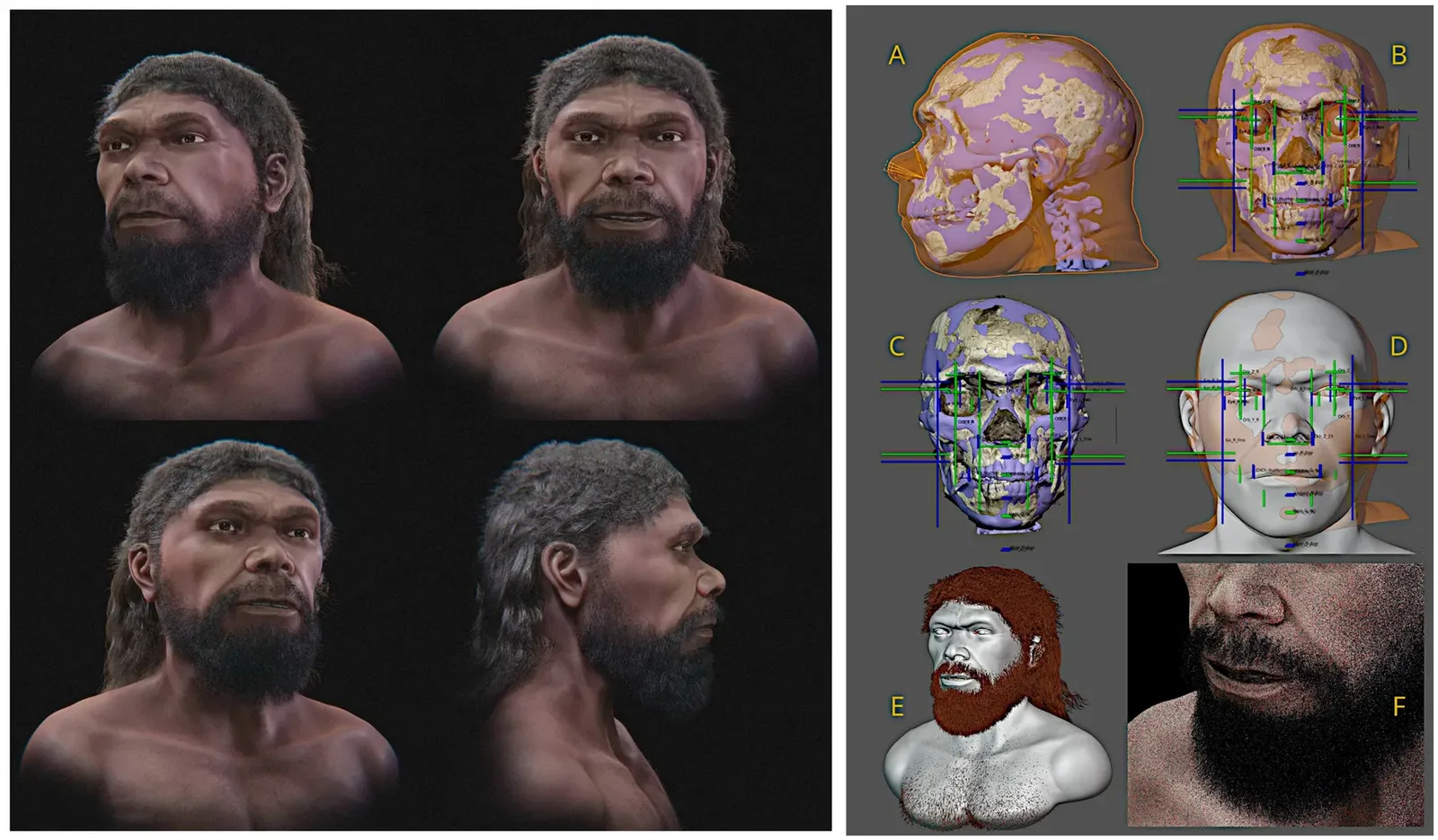
An international team has used forensic facial approximation to give a face to one of the earliest members of our species. The study, published in the journal Heritage in September 2026, is based on fossils from Jebel Irhoud in Morocco. It was led by Cicero Moraes with Elena Varotto, Michael Habicht, Francesco Maria Galassi, Lis Moura and Johari Yap Abdullah.
Why Jebel Irhoud matters
The first skull was found by a mine worker in the early 1960s and was initially thought to be an African Neanderthal. Dating methods improved over the following decades, and in 2017 two papers in Nature reclassified the fossils as Homo sapiens. They also pushed the age back to about 315,000 years, which makes them the oldest remains attributed to our species.
Working from a composite skull
The team started with a 3D composite skull released by the Max Planck Institute for Evolutionary Anthropology in 2017. It combines several fossils from the same layer of the site. The 1961 Irhoud 1 specimen supplies the braincase and upper face, a mandible from the same layer fills in the lower jaw, and other specimens complete the upper teeth. The authors say they used the composite as a geometric reference. They did not set out to test how well it was assembled.
Forensic methods, free tools
The approach follows the same logic used to estimate faces from unidentified skulls. The researchers digitised the skull from video using photogrammetry. They then deformed a modern CT-based virtual donor so that it matched the fossil’s shape, keeping the result tied to the fossil’s bone structure. Soft-tissue thickness values from modern African populations were used as a proxy, since no such data exist for Middle Pleistocene humans. All the work was done in Blender with the free OrtogOnBlender add-on.
What the numbers showed
The internal volume of the braincase came out at 1,364 mL. That is close to the 1,375 mL that other researchers obtained directly from CT scans of the fossil, and within the range of modern humans. The reconstructed head circumference was about 60 cm. The skull’s model dimensions also matched published measurements and an independent 3D scan made by another researcher.
Two versions of the face
The team produced two sets of images. One is a neutral grayscale version with no hair, for studying the underlying anatomy. The other is a coloured artistic version with skin tone, hair and facial hair. The authors stress that these extras are speculative and are meant to make the work easier for the public to engage with.
Limits the authors acknowledge
There is no preserved soft tissue from this period, so the face cannot be directly validated. The authors describe it as a morphologically plausible approximation and not a definitive portrait. They note that the technique has been tested on other cases since 2013, including a historical skull attributed to Mozart and forensic cases. They have also made the 3D bust available for download so others can check it.
Why it matters for forensic science
The study shows that free, transparent tools can support reproducible work on complex skeletal material, whether the skull is a fossil or a modern forensic case.
Source: Moraes, C. et al., “Digital Facial Approximation of Jebel Irhoud Composite Skull (~315,000 BP),” Heritage 2026, 9(9), 369. DOI: 10.3390/heritage9090369.