
Why this case still matters
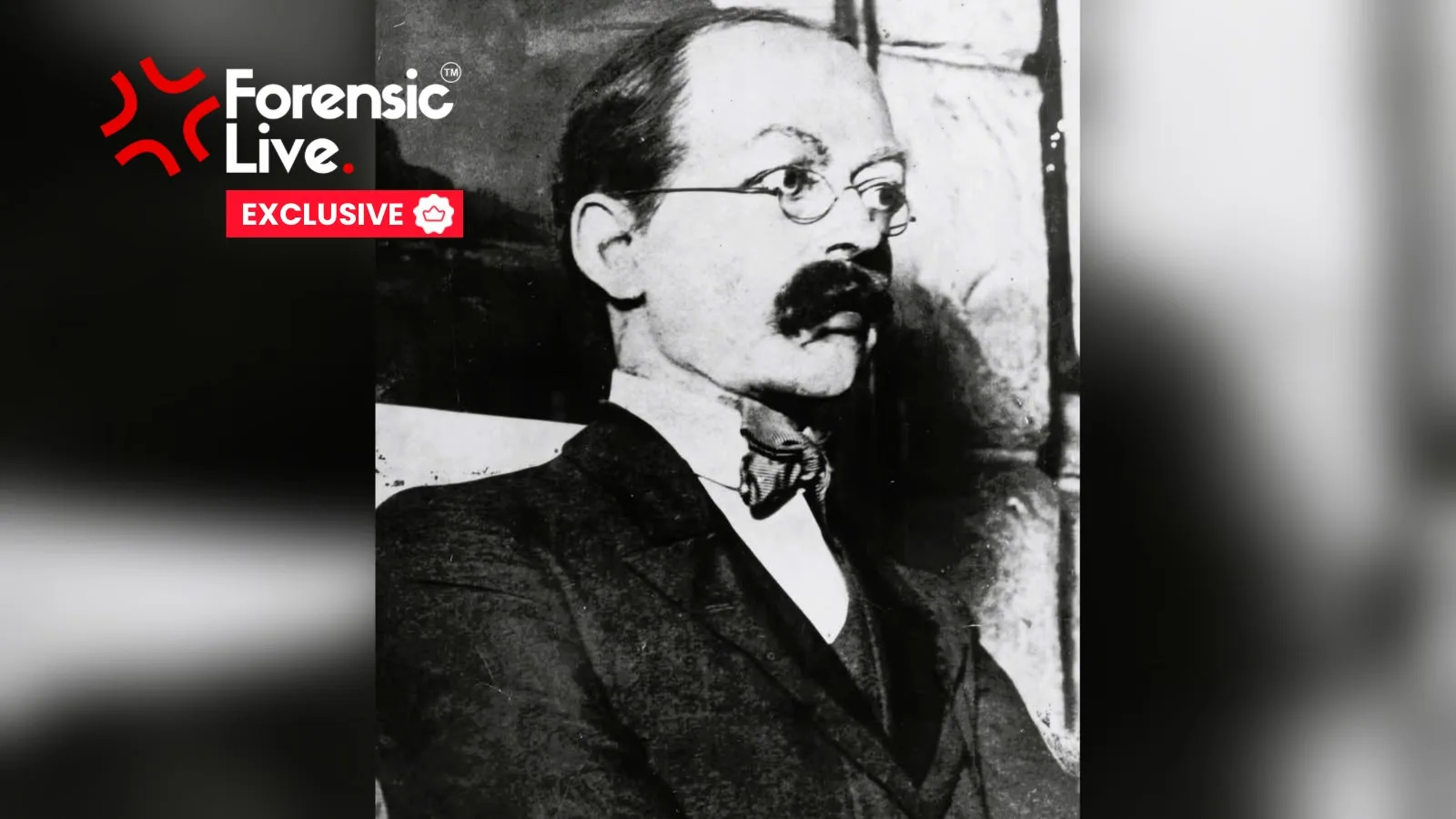
Most students meet Crippen as a footnote: the murderer caught by radio. That is the least interesting thing about him. Look closer and you find a case that raises questions every forensic student must still answer today. How do you identify a body that has been deliberately destroyed? What counts as proof of poisoning? And what happens when a landmark conviction is questioned a century later, by a science that did not exist at the time?
The case at a glance
- Accused: Dr. Hawley Harvey Crippen, an American-born homeopath living in London
- Victim: Cora Crippen, a music hall performer known on stage as Belle Elmore
- Last seen alive: 31 January 1910, after a dinner party at the family home, 39 Hilldrop Crescent, North London
- Cause alleged: Poisoning by hyoscine, followed by dismemberment and burial in the cellar
- Trial: Old Bailey, October 1910
- Outcome: Convicted of murder and hanged at Pentonville Prison on 23 November 1910
The disappearance
After that January evening, Cora was never seen again. Crippen told friends she had returned to America, then that she had fallen ill and died. Her friends in the music hall world were not convinced, and one of them took her suspicions to Scotland Yard. Crippen's behaviour gave the story away: his companion Ethel Le Neve was soon seen wearing Cora's jewellery.
The search that found nothing, and then everything
Chief Inspector Walter Dew interviewed Crippen and searched the house. He found nothing. Crippen then did what innocent people rarely do: he fled. He and Le Neve, disguised as a boy, left for Belgium and boarded the SS Montrose for Canada.
Dew went back to the house and searched again, this time properly. Beneath the brick floor of the cellar he found human remains.
Forensic point 1: A body with no face
The remains had no head, no limbs and no skeleton. The identification problem was severe. This is where the case becomes a lesson in method.
Pathologist Bernard Spilsbury, then a rising young figure at St Mary's Hospital, examined a piece of skin from the abdomen. He identified a scar, which he linked to a surgical operation Cora was known to have had. A fragment of pyjama jacket found with the remains was also traced back to Crippen's own purchases. Together, the scar and the pyjamas tied the remains to the household.
Student takeaway: Identification does not rest on one fact. It rests on converging lines of evidence: medical history, physical features, associated objects, and the circumstances of discovery.
Forensic point 2: Proving poison without a body to show for it
Home Office analyst Dr. Willcox tested the remains and found hyoscine, a powerful sedative poison. Records showed that Crippen had bought hyoscine from a chemist shortly before Cora vanished. This mattered legally. It supplied both the means and the link to the accused.
Student takeaway: In a poisoning case, the chain runs from purchase, to opportunity, to detection in tissue. Break any link and the prosecution weakens.
Forensic point 3: The wireless telegram
The Montrose's captain, Henry Kendall, noticed two passengers behaving oddly, one of them a slight "boy" who held hands with an older man. He sent a wireless telegram to Britain. Crippen is widely remembered as the first criminal caught with the help of wireless telegraphy.
Dew boarded a faster ship, overtook the Montrose, and boarded it disguised as a pilot. Crippen was arrested on 31 July 1910.
Student takeaway: Technology reshapes investigation. A communication tool can matter as much as a laboratory.
The trial
The trial was fast. The prosecution relied on the remains, the hyoscine, the flight, and Crippen's own lies. The jury took only minutes to convict. Ethel Le Neve was tried separately and acquitted.
The twist: a century later, the science fights back
In 2007, a team led by forensic scientist David Foran at Michigan State University tested tissue from the original evidence, preserved on a microscope slide. Using mitochondrial DNA analysis, they reported that the tissue did not match Cora's maternal relatives. Their work, published in a forensic journal, suggested the remains may not have been Cora's at all.
This result is not the end of the story. Critics point to the age of the specimen, the chances of contamination or mix-up in a sample handled for decades, and the strength of the rest of the evidence. Note too that the tests were on one preserved slide, not on the full body of evidence. The result reopened a debate, but it did not formally overturn the conviction.
What the Crippen case teaches the modern forensic student
- Identification is a process, not a moment. Expect to build it from several independent sources.
- Chain of custody lasts forever. A sample preserved for 100 years can still be cross-examined.
- Science evolves, courts must keep up. DNA did not exist in 1910. It can still rewrite a 1910 case.
- Experts shape verdicts. The authority of an expert witness can be decisive, which is why transparency and peer review matter.
- Behaviour is evidence, but not proof. Flight and lies point to guilt without establishing it.
The last word
Crippen's case is often told as a story of a cunning killer and a clever chase. For the forensic student it is more useful as a warning and a model. It shows both the power of early forensic science to speak for the dead, and the danger of treating any single expert opinion as final.
Want more cases like this? Explore the Forensic Live research hub for case studies, journal alerts and exam-ready summaries.