
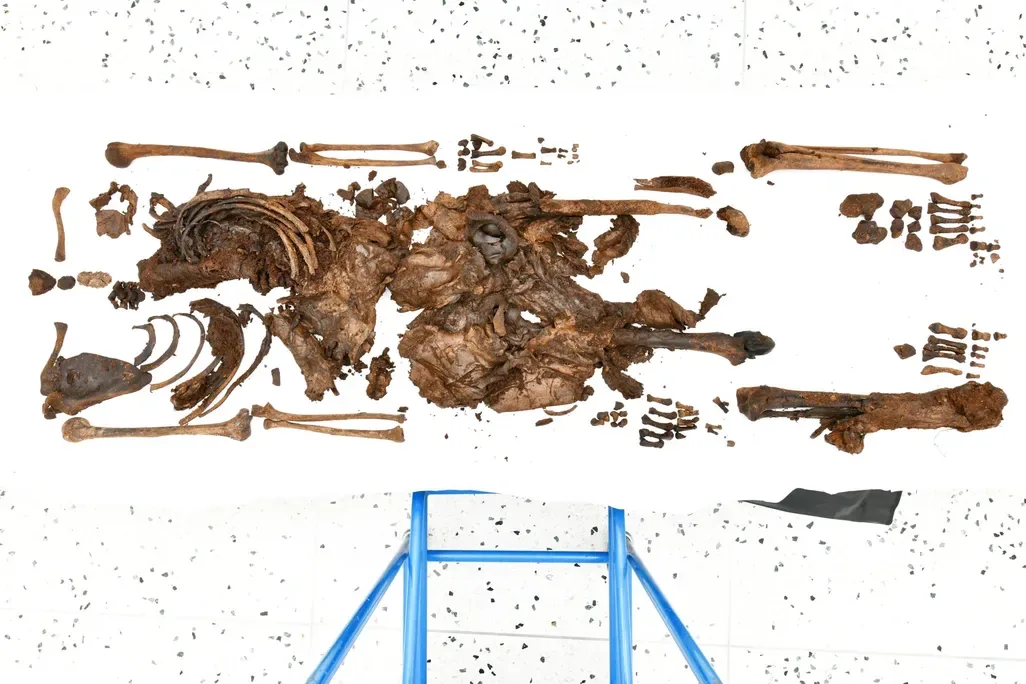
A young woman who lived in the Iron Age was deliberately beheaded from behind with a bladed weapon, according to an inquest-style inquiry held in Belfast. Her remains were found in a peat bog in 2023.
The hearing took place at the Ulster Museum and drew on research from an international consortium led by National Museums NI. It was not a formal legal inquest, but it applied present-day investigative standards to evidence from a death more than twenty centuries ago. The coroner who chaired it, Joe McCrisken, explained that the aim was not to impose modern legal conclusions on the distant past, but to give the evidence a framework so that her story could be told.
Discovery in a County Londonderry bog
Peat workers uncovered the bones in October 2023 at Ballymacombs More, near Bellaghy. Later excavations recovered more skeletal remains and a woven object, but no skull. Researchers first believed the body was male and nicknamed it “Bellaghy Boy”. Forensic testing then showed the remains belonged to a woman aged between 15 and 22, and she became known as the Ballymacombs More Woman.
What the science showed
Researchers from nine institutions used micro-CT scanning, digital mapping, 3D imaging and targeted analysis of preserved bone, hair, skin, nails and the textile. These methods gave them clues about her diet, health and appearance. Cut marks on her neck indicated she was intentionally decapitated in the bog.
Why was she killed?
The reason remains unknown. Niamh Baker, NMNI’s curator of archaeology, said the death could fit a pattern of ritual sacrifice seen across northwest Europe in the Iron Age. Comparable male remains found in the Republic of Ireland have been linked to positions of leadership, which raises the question of whether she held high status. Baker also suggested the killing might have been connected to agricultural or weather problems of the time.
A rare find
Hannah Crowdy, head of curatorial at NMNI, said finds of women like this are extremely rare and that she is the first of her kind in Northern Ireland. The Ballymacombs More Woman now joins famous bog bodies such as Denmark’s Tollund Man and Grauballe Man and Ireland’s Clonycavan Man and Old Croghan Man.
Remembered by her community
Residents of Bellaghy have embraced her and named her Áine, after an Irish goddess. A member of the Bellaghy Historical Society said the community felt she needed her own people present to speak on her behalf at the inquiry.
As the Ulster Museum updates its Early Peoples gallery, curators have decided not to display her remains. They will evoke her life through illustration and poetry instead, a choice that reflects wider questions about how human remains are cared for in museum collections.